"Why aren't we ranking?"
Before anyone touches copy, I audit whether the code even lets Google reward the page: rendering, headings, metadata, crawlability. Tech debt first.
If your website is missing meta tags, skipping heading levels, or hiding content behind JavaScript, the copy describing your business or products is window dressing. Websites need to be fast, responsive, accessible, and usable.
The first hour with any site works the way an ER works: before a doctor ever sees you, a nurse checks your vitals. I check Core Web Vitals. Lighthouse, CrUX field data, WAVE, and the site on an actual phone, not to fix anything yet, but to learn what Googlebot learns on its first pass. That hour answers a question no rankings report can: is this website serious?
An unserious site isn't built for mobile, where most of the world actually browses. It's bloated, slow, and shifting while it loads, and users leave before it settles, a pattern search engines see too. Then accessibility, the single strongest signal of intentionality a site gives off, because a site that gets screen readers right almost always gets UX right everywhere else. Then authority: the backlink profile is a gut check on how much the rest of the web trusts the domain, and how steep the climb to ranking will be. Then the platform, because the path forward on hand-written HTML and the path forward on a React frontend are different animals.
From there, the work has an order. Fix cannibalization so your own pages stop competing with each other. Figure out what your organization's E-E-A-T actually is: not the acronym, the expertise you can prove. Create and grow share of voice around it. Interlink pages so authority flows where it should. Keep sitemaps organized and current so crawlers always have a clean map.
Last, the content audit, which is where the work turns into fun. I get to learn a new industry from scratch: the business, its objectives, and the competitive landscape, and while I learn it I keep a running list of every question I had and how I wish someone had taught me the space. Those notes become the content clusters. The goal is E-E-A-T you can prove: be the site that takes the time to educate, freely, adjacent to the incentive to purchase rather than gated behind it, because nobody trusts a source that paywalls the basics. From there it's structure: how this domain captures share of voice, whether that's glossaries, free tools, or the knowledge nobody else in the industry bothered to write down.
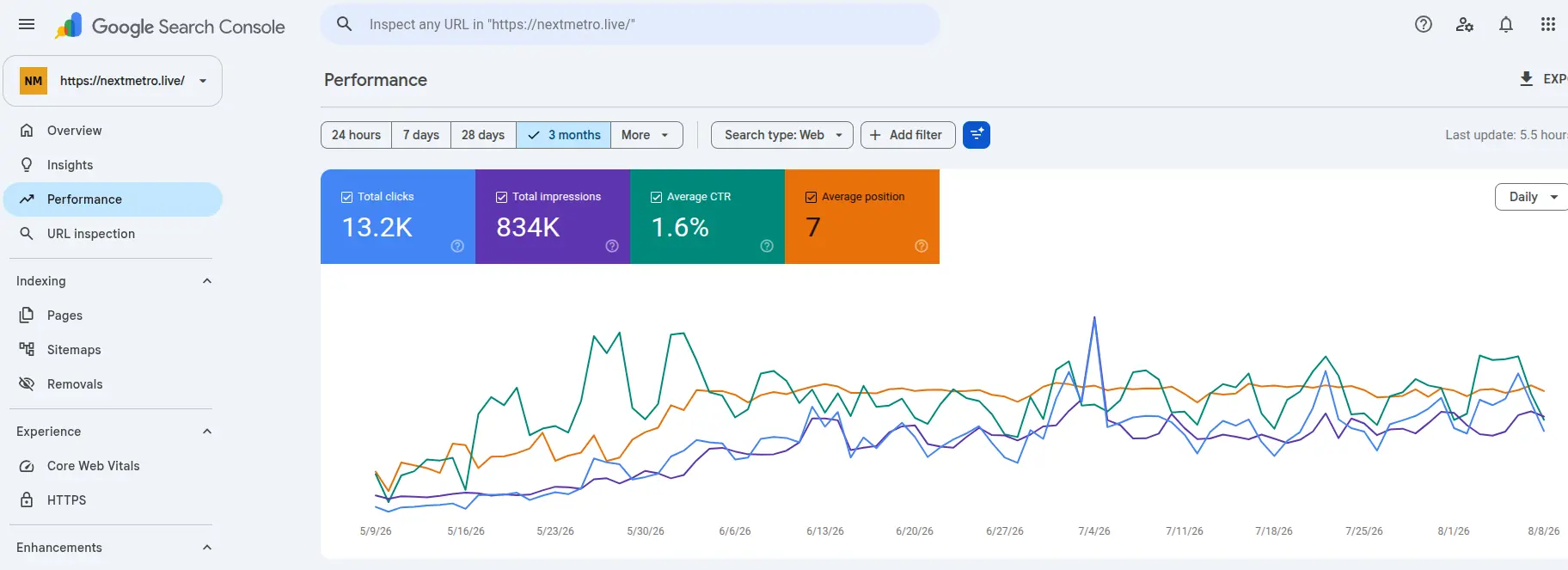
Across search, organic clicks have been decoupling from impressions: impressions hold, average position holds or improves, and clicks thin out anyway. The industry took a while to agree on a name for it. When that signature appeared in a national building-products category, the standard playbook said ranking problem. The evidence said something else: AI Overviews were intercepting queries and answering them above the links.
I ranked the competing explanations against the data the way an analyst ranks hypotheses, presented the diagnosis to leadership, and rebuilt measurement around answer-engine visibility: generative prompt groups tracking brand mentions, citations, and share of voice in ChatGPT and Google AI Overviews across every product category, with pre-launch AI answer baselines logged to define displacement targets.
From rank tracking to answer-engine share of voice, measured against named incumbents.
On a small core team, I led the SEO workstream for a ground-up replatform to Sitecore XM Cloud on a headless Next.js frontend. The governing framework was a 40+ page SEO strategy and technical requirements document I authored for the implementation agency: crawl budget, URL architecture, canonical logic, hreflang, and structured data standards.
I authored the content for the entire relaunched site: every core page, its metadata, and its UX copy, exceeding the MVP content target. I wrote the production robots.txt and deployed llms.txt for AI crawler guidance, and designed the structured data architecture, from NewsArticle schema for the press release archive to a Product schema pipeline specified from PIM data.
SEO built in from the ground up, not retrofitted after launch.
Content and code are never in sync by accident. Getting them in sync is intentional work, and it is work most audits skip. While others write and rewrite the copy on a page trying to move its rankings, I read the DOM underneath it, because what good are words if search engines can't see them? Incorrect code caps a page no matter how good the words are.
Running pre-launch UAT for the relaunch, that meant testing the site the way machines and assistive tech experience it: raw HTML against the rendered DOM, heading order, anchor text, contrast, and ARIA. Make sure what we designed is what crawlers and screen readers actually get.
One example: every product card linked with the same "View Details" label. Repeated generic anchors tell search engines nothing about the destination and force screen reader users to guess. The fix I delivered used the product name as the link with a stretched-link pattern covering the card, written as paste-ready code. Findings shipped as structured tickets framed as implementation requests, holding launch standards while keeping the agency partnership productive.
Another: a careers page comp came through with a beautiful creative line as its H1. It read great and told search engines nothing. The fix kept both jobs intact. "Careers" became the H1 that machines and job seekers actually search for, and the creative line found a proper home in a blockquote midway down the page. Nothing was lost. Everything became findable.
Designers optimize for feeling. Developers optimize for efficiency. I translate between them for the audience neither is thinking about: the machines deciding whether anyone finds the page.
I surface search insights into the decision conversations that matter. Brand teams get the SERPs worth targeting, intent matching, competitor analysis, and search volume research so the keywords we chase are maximum and intentful. Executive leadership, project managers, and stakeholders get plain explanations of how Google actually works and operates. In rooms where search has no other representative, I am the voice of the search engines.
In practice that has meant search-driven naming briefs with evidence-backed recommendations and live SERP exhibits, presented to brand management and legal across six product launches. It also means informing PR strategy: I founded a biweekly PR and SEO task force focused on E-E-A-T signals, backlink strategy, and thought leadership alignment.
Search intelligence shaping what products are called, how they launch, and what PR pursues.
I evaluated the enterprise SEO platform market, authored the value proposition that moved the organization from Conductor to BrightEdge, and own the configuration end to end: keyword architecture in a four-layer tag system, competitor tracking, decannibalization via preferred-page assignments, and AI Catalyst prompt groups.
I also brought product copy production in-house from an external vendor. I built a governed AI content system in Jasper loaded with brand voice, SEO standards, and copy frameworks, then personally authored the full catalog: standardized product detail copy and web cards across 223 SKUs.
Tool strategy, procurement advocacy, and content operations, owned as one system.
Before that: SEO, quality, and accessibility governance across 80+ public-facing properties at CareFirst BlueCross BlueShield: Siteimprove administration, content audits that identified and resolved 2,400 issues while improving UX metrics by 32%, and accessibility and QA issues reduced by over 60%, all while holding WCAG 2.1 AA and Section 508 in a HIPAA-regulated environment.
Proof that search performance and compliance are allies, not trade-offs.
{
  "@type": "WebPage",
  "@id": "…/expertise/seo/#webpage",
  "isPartOf": {
    "@id": "https://nickpoole.dev/#website" },
  "about": {
    "@id": "https://nickpoole.dev/#nick-poole" },
  "author": {
    "@id": "https://nickpoole.dev/#nick-poole" }
}
This page does not repeat who I am. It points at the one Person node the site declares, so an answer engine reading any page resolves to the same entity. An SEO whose own site can't explain itself to a machine isn't one you should hire. See the entity graph
Before anyone touches copy, I audit whether the code even lets Google reward the page: rendering, headings, metadata, crawlability. Tech debt first.
Ranking loss, SERP interception, or AI capture, diagnosed from evidence before money is spent fixing the wrong problem.
Search encoded into architecture, redirect maps, and standards documents, not tribal knowledge that leaves with a vendor.
Naming, launches, PR, and executive translation. Search represented where decisions actually get made.
Every keyword, content brief, and AI prompt group maps to one of five intent stages, a framework I built and operationalized as an organizational standard.